|
What IS a head gasket? |

 |
The internal combustion engine is constructed of many layers: bearing ladder, block and cylinder head. The K-series engine installed in the MGF/TF is no different, although perhaps a little more complex. Illustrated in the figure opposite is the cylinder head and block. Between these layers there is a gasket. The gasket is inserted to ensure adequate sealing between metal mating surfaces to prevent leakage of fluids and gases.
 |
There is a gasket between the cylinder block and the cylinder head
(shown in figure opposite, right). This gasket plays a vital role - not only prevent the
seepage of oil (as with the gasket found between the sump and main bearing ladder), but
also of coolant and combustion gases - the latter of which is at very high temperature and
pressure.
If the gasket fails, then oil, coolant or combustion gases may be able to escape, with
potential dire consequences to the engine:
- loss of compression in one or more cylinders, causing a misfire and loss of power.
- loss of coolant, and subsequently overheating of the engine (which, with an alloy design such as the K-series, will cause extensive damage and warping of the head and other castings)
- loss of oil lubrication, with potential damage to the reciprocating and rotating internal components of the engine.
- Mixing of oil and coolant, causing the oil to emulsify. The ensuing sludge does not circulate well, and causes overheating.
If, for any reason a head gasket failure is suspected, immediately
switch off the engine and seek expert advice.
The anatomy of a Cylinder Head Gasket
First, the original type of cylinder head gasket used on the K-series: the elastomeric head gasket
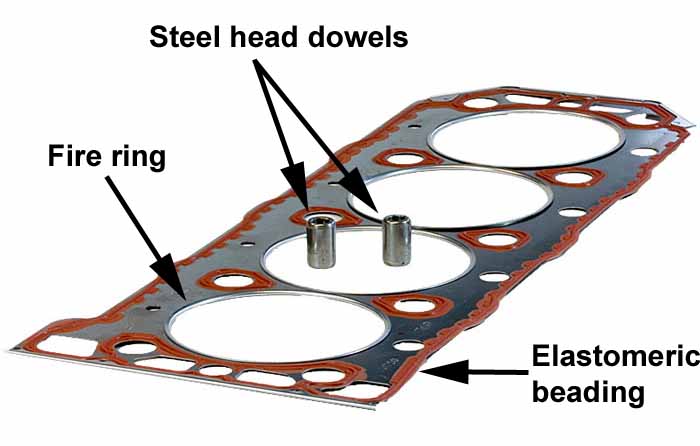
The standard head gasket used on all MGFs and TFs looks like the one pictured above. This is the "classic" elastomeric head gasket. It comprises of a single layer of thin steel. There are multiple holes, as you can see. The four large ones are for the cylinders. Note how for each cylinder there is a circular reinforcement - a "u"-shaped circle of extra material? This is the fire ring - and enables the gasket to seal against release of high temperature and high pressure products of combustion from leaving the combustion chamber from any other route than the one the designers intended!
There are many other additional, smaller holes - these are for the oil and coolant passages. These are each surrounded by an orange-coloured bead - the elastomeric bead. This rubber-like substance forms a fluid-tight seal to prevent coolant or oil escape.
The elastomeric bead also forms a perimeter seal around the edge of the gasket.
The image above also shows a pair of steel cylinder head location dowels. Steel is the latest specification - earlier engines were fitted with plastic items that were later thought inadequate for tight location of the cylinder head on the engine block - and a potential contributor to the gasket failure problem on the K-series.
The Land Rover MLS Gasket is a more recent development, since 2005:
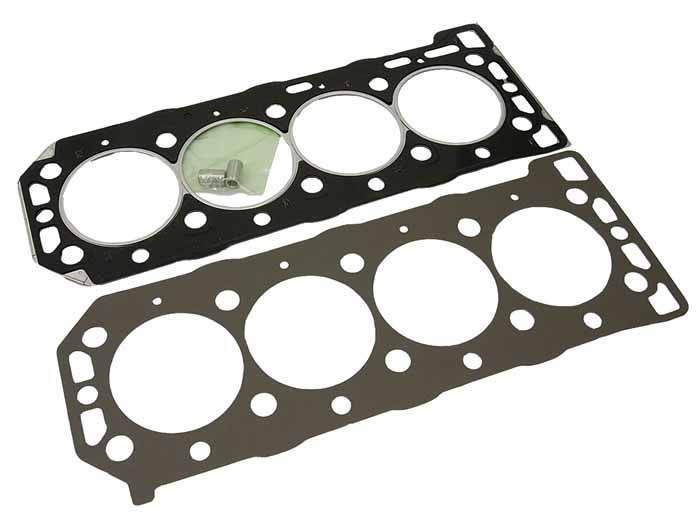
MLS stands for Multi-Layer Shim gasket. As can be seen, it is quite different from the earlier elastomeric type. The elastomeric beads have been replaced by a resin-like coating of the original gasket, and a separate "shim" has been added - which has some advantages, particularly if there are concerns regarding the porosity of the cylinder head.
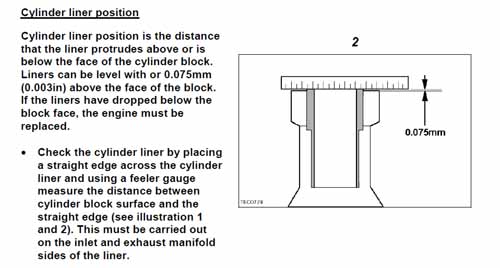
However, this gasket is exquisitely sensitive to the liner heights. Earlier K-series engines were designed to have cylinder liners that were flush with the block face. MLS gaskets however require at least 0.075mm of stand-proud from the block face (as shown below, reproduced from Land Rover Freelander service bulletin 0036 from June, 2004). If the liners are too low, or the heights not consistent across all four, then the earlier elastomeric head gasket is actually the more reliable type.
Modes of Head Gasket Failure on the Rover K-series
 |
A head gasket failure (HGF) is said to occur when there is a breech of the gasket, allowing the escape and potentially mixing of water, oil and combustion gases.
Opposite right shows an engine being stripped down following an HGF. In the oil galleries, instead of normal brown honey-coloured oil, there is brown emulsion everywhere, signifying a failure of the gasket between the oil and coolant passage ways. This engine will need its oil ways and cooling system thoroughly flushed out before reassembly. Apparently, dish washer tablets are quite effective at removing oily deposits from difficult to reach locations if used in neat water on reassembly, and then thoroughly flushed before re-filling the system with the correct antifreeze mixture!
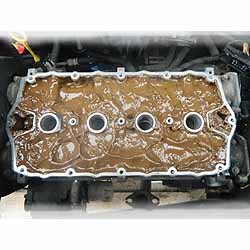
Perhaps the commonest HGF on the Rover K-series is where there is mixing of oil and water to give the characteristic brown sludge, also referred to as "mayonnaise" thanks to its consistency of an oily emulsion. Typically this is due to a failure of the gasket around the oil or water ways allowing break through and mixing of the two fluids.

Less commonly, the gasket can fail externally, leading to coolant leakage. This leakage can be quite vigorous as shown in the image to the left: a stream of coolant can be seen exiting the gasket (A) over the top of the alternator. A displaced section of the elastomeric beading can be seen poking out between the head and block (B).
Assuming that not too much coolant has been lost, this is
the cheapest type of gasket failure to repair.
The third type of gasket failure commonly found on K-series engines is
exhaust gas blowing past the gasket fire ring, leading to pressurisation of
the coolant system, and coolant loss past the expansion tank pressure cap.
The coolant loss can be quite variable - and depends on how the car is driven. Light driving may give rise to only minimal coolant loss, but as soon as you use the engine revs and put some load on the engine, the coolant will rapidly blow out.
Diagnosis can be made using an exhaust gas analyser or "sniffer" to detect products of combusion in the coolant system.
The commonest way to get fire ring failure is through over-heating of the cylinder head, leading to the alloy becoming soft. The liners then hammer deep grooves that the head gasket no longer has be capacity to seal. Cylinder head over heating usually occurs as a consequence of coolant loss of what ever cause. This can be bad news: having to buy a replacement cylinder head is not something one would like to be having to contend with - but it needs to be carefully looked for, or else the gasket is very likely to fail again in the near future.
Other causes of fire ring failure include excessively lower cylinder liners. An engine block can be recovered if the block face is carefully linished to ensure that the liners have adequate stand-proud from the block face to ensure good fire ring sealing.